Feast of Feasts
Holy Pascha
The Resurrection of Christ
When: Pascha itself. Next: Sunday, May 2, 2027 (New Calendar).
Pascha is the celebration of Christ’s rising from the dead on the third day after His crucifixion, as all four Gospels relate. For Orthodox Christians it is the “Feast of Feasts”: the center of the whole church year, from which the dates of Lent, Pentecost and many other days are counted.
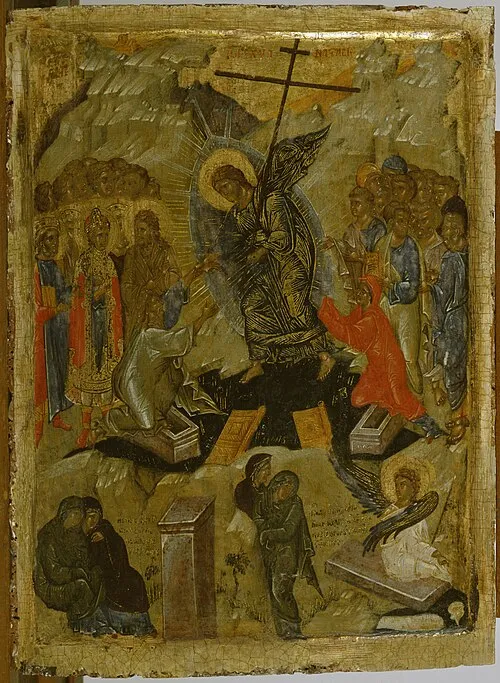
The traditional icon does not show the empty tomb so much as Christ’s descent into Hades: He stands on the broken gates of death and pulls Adam and Eve up by the hand.
Pascha begins at midnight with a candlelit procession and the joyful greeting “Christ is risen!” – “Indeed He is Risen!”, which replaces ordinary greetings for forty days. The week that follows, Bright Week, is fast-free.
What to expect
The date is moveable, set by the traditional Orthodox (Julian) tables, and may coincide with Western Easter or fall later, always between April 4 and May 8 on the civil calendar. The day itself is fast-free. The greeting is used until the leave-taking of Pascha on the Wednesday before Ascension.
The main service begins late on Holy Saturday, often around midnight, and commonly lasts two and a half to four hours. The church is darkened. The priest brings a single light from the altar — in some parishes, the Holy Fire from Jerusalem — and everyone lights candles. An outdoor procession moves around the building with candles, the cross, and icons. At the closed doors the priest announces “Christ is risen!” and the people answer “Indeed He is Risen!” The doors open, and joyful Matins and Liturgy follow. The troparion is: “Christ is risen from the dead, trampling down Death by death, and upon those in the tomb bestowing life.” The Liturgy readings are Acts 1:1–8 and John 1:1–17.
Red eggs are often cracked while the greeting is exchanged. Many Slavic, Romanian, and Ukrainian families bring baskets of foods not eaten in Lent to be blessed after the service or on Thomas Sunday. Greek and Antiochian families more often go home to a festive meal with red eggs and sweet bread. Parishes usually provide candles; wear comfortable shoes.
Local custom varies. Ask your priest or a longtime member how it's done in your parish.
The Paschal troparion, from I. F. Hapgood, Service Book of the Holy Orthodox-Catholic Apostolic Church (1906), p. 1 (and throughout Eastertide). Public domain.
Written for this app in our own words from the Gospels and long-standing Church tradition. All Great Feasts & Holy Week · Calendar